Grinding dust
Capture airborne fines around hammer mills.
 Request quotation
Cyclone and bag-filter dust collection systems for biomass grinding, drying, pelletizing, conveying and charcoal processing lines.
Get configuration & price →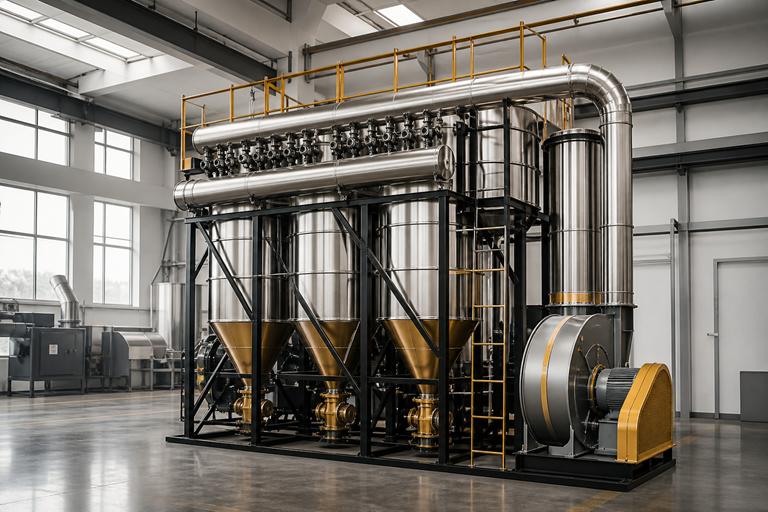
Useful dust-control design starts with pickup points, air volume, particle properties and temperature. We size the hood, duct, separator, filter and fan as one system.
Discuss your material →Effective dust control requires source capture and airflow engineering—not only a filter. NovaGen defines pickup points, ducts, air volume, dust properties, temperature and discharge method as part of the production line.
Capture airborne fines around hammer mills.
Separate entrained solids from process gas.
Control dust at cooling, screening and transfer.
Project-specific capture of carbonaceous dust.
Hoods collect dust near its source.
Duct velocity carries particles reliably.
Cyclone removes coarse material.
Filter media captures fine particles.
Airlock or screw removes collected dust.
| Selection factor | What we need | Why it matters |
|---|---|---|
| Dust loading | Concentration and particle distribution | Controls separator and filter size |
| Air volume | Each pickup-point requirement | Controls ducts and fan |
| Temperature | Normal and upset conditions | Controls filter media |
| Hazard review | Combustibility and ignition sources | Controls protection requirements |
Cyclones efficiently remove coarse particles; bag filters capture finer dust. Many systems use both stages.
Fan selection uses required airflow plus pressure losses through hoods, ducts, separators and filters.
Fine combustible dust can present fire or explosion hazards. A project-specific risk assessment and suitable protective measures are necessary.
Send a few material photos, the hourly target, required output and destination country. We will reply with any missing questions before recommending a configuration.